
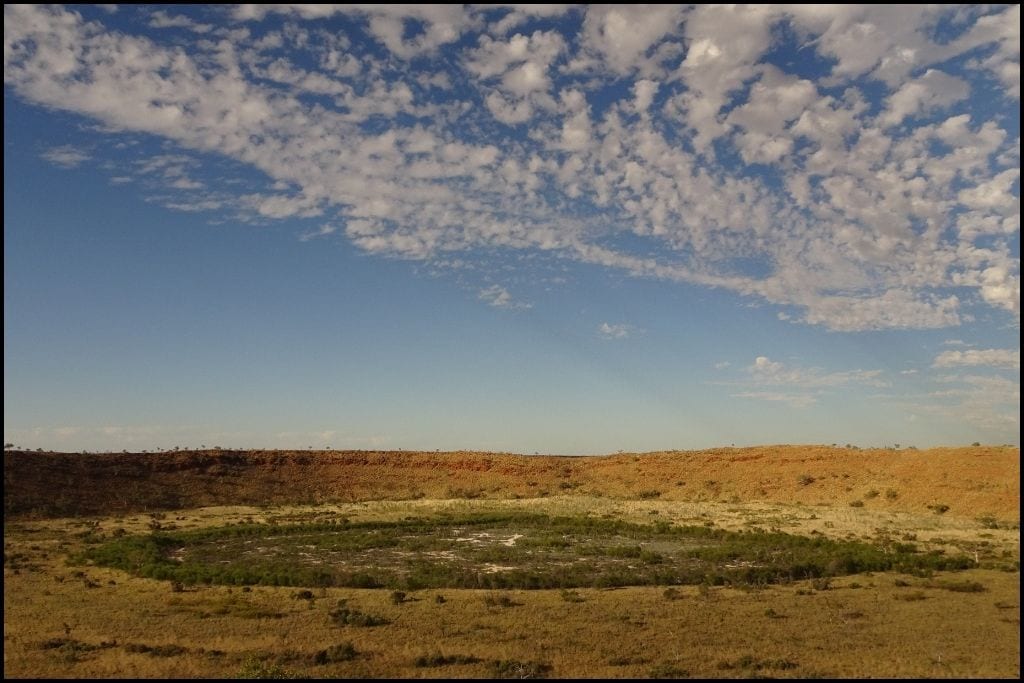

Wolfe Creek Crater (Kandimalal)
Overview
Wolfe Creek Crater, known as Kandimalal, is one of the largest and most intact meteorite impact craters in the world. Located in the East Kimberley, it is a significant geological site and an important place on Jaru Country.
The crater’s scale and clarity make it one of the most visually recognisable impact sites in Australia, and its remoteness is a defining part of the experience.


Formation and Geology
Kandimalal formed approximately 300,000 years ago during the Pleistocene epoch when a large iron–nickel meteorite struck the Earth at high speed. The impact created a crater around 875 metres in diameter and 60 metres deep, ejecting material outward to form the raised rim that remains clearly visible today.
Although erosion has softened the edges over time, Wolfe Creek Crater is considered one of the best-preserved meteorite craters of its size globally.
Cultural Context
Wolfe Creek Crater lies on Jaru Country and holds cultural significance alongside its scientific importance. The site forms part of a wider cultural landscape that predates its recognition as a geological feature.
Visitors are encouraged to approach Kandimalal with respect and awareness of its cultural context.
Visiting Wolfe Creek Crater


Most visitors explore the crater on foot, walking sections of the rim or descending into the basin to understand its scale. The experience is quiet and self-directed, shaped by the openness of the landscape rather than signage or facilities.
This is not a destination built around infrastructure. Its impact comes from space, silence, and scale.
Getting here is via the Tanami Track. The turnoff for the Tanami is only 16 kilometres from Halls Creek. Expect a heavily corrugated dirt road. This is 4WD only and knowing how to drive in remote Australia is essential. The first 30 km from the turnoff from the Great Northern Highway is bitumen.
If you are here and are heading towards the Gibb River Road, Broome, The Bungle Bungles or Kununurra are great locations to continue your Kimberley Adventure.
Camping and Access


Camping is available near the crater for those who wish to stay overnight, but facilities are minimal and visitors must be fully self-sufficient. No potable water.
For practical information on camping conditions, access routes, and preparation, see the dedicated guide:
→ Kandimalal (Wolfe Creek Crater) Camping Guide
Why Wolfe Creek Crater Matters

Wolfe Creek Crater stands out not just for its size, but also for remaining essentially unchanged by development. It offers a direct encounter with deep geological time in a setting that still feels remote and undisturbed.
For travellers interested in the Kimberley’s natural history and large-scale landscapes, Kandimalal is a destination of substance rather than spectacle.
Wolfe Creek Crater is Definitely worth a Visit


